We are SMFG India Home Finance Co. Ltd.

 Login
Login
80:20 Home Loan Rule: What You Need to Know Before Buying a House

The 80:20 home loan rule is a financial arrangement designed to assist individuals in purchasing a property by dividing the cost into two portions: one funded by the lender, and the other by the buyer. Under this rule, the lender covers 80% of the property's value, while the borrower is responsible for the remaining 20%. This approach is commonly used to make homeownership more accessible, especially for those without sufficient savings to cover the full cost upfront.
However, while the 80:20 home loan rule may seem like an attractive option, it’s crucial to fully understand how it works, its advantages and potential drawbacks, and when it might be the right choice for you.
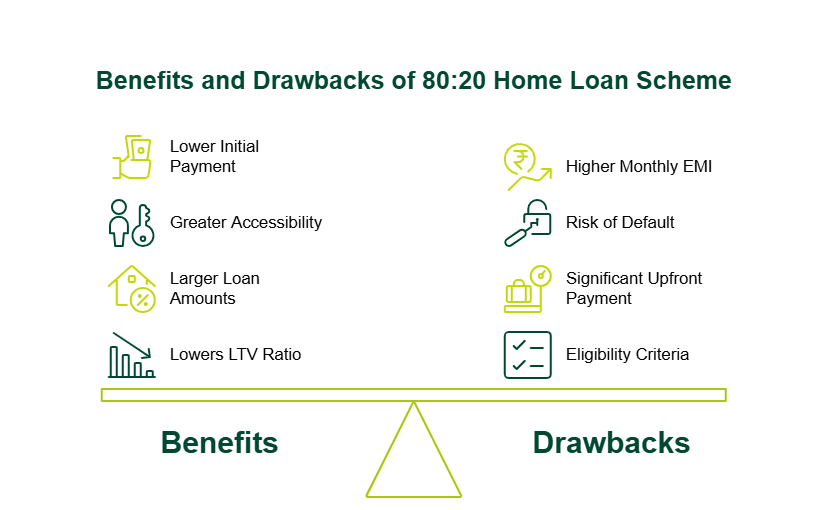
Benefits of the 80:20 Home Loan Scheme
The 80:20 home loan thumb rule offers several advantages for both the borrower and the lender. Below are some key benefits of this scheme:
1. Lower Initial Payment Requirement
One of the most attractive aspects of the 80:20 rule is that it reduces the initial financial burden on the borrower. Instead of needing a large sum of money to cover the entire cost of the property, the borrower only needs to pay 20% of the property’s value upfront.
2. Greater Accessibility to Homeownership
Saving the entire amount for a home can be challenging, particularly for first-time buyers. The 80:20 scheme bridges this gap by allowing buyers to borrow a larger portion of the property’s value, making homeownership more accessible.
3. Helps You Secure Larger Loan Amounts
Under this scheme, eligible borrowers can obtain a higher loan amount since the lender covers 80% of the property value. This is particularly beneficial for individuals purchasing higher-value properties or those looking to invest in real estate in urban areas where property prices are steep.
4. Lowers Loan-to-Value (LTV) Ratio
For financial institutions, funding 80% of the property value results in a manageable Loan-to-Value (LTV) ratio. A lower LTV ratio signifies reduced lending risk, making lenders more willing to approve loan applications. Additionally, a favourable LTV ratio can sometimes lead to more competitive interest rates for borrowers.
Drawbacks of the 80:20 Home Loan Scheme
While the 80:20 home loan rule offers several benefits, it also comes with a few drawbacks that potential homebuyers need to consider. Here are some of the disadvantages:
1. Higher Monthly EMI
Since the lender funds 80% of the property value, the loan amount borrowed is substantial. This translates into higher Equated Monthly Instalments (EMIs), which can strain the borrower’s monthly budget, especially if interest rates are high or the loan tenure is short.
2. Risk of Default
Borrowers must ensure timely repayment of EMIs to avoid defaulting on the loan. Defaulting not only results in penalties but also risks the lender seizing the property to recover their dues.
3. Significant Upfront Payment
While the scheme reduces the overall financial burden compared to paying the full property cost upfront, the borrower must still provide 20% of the property value as a down payment. For high-value properties, this can amount to a significant sum, potentially requiring years of savings.
4. Approval Subject to Eligibility Criteria
Lenders typically have specific criteria for approving loans under the 80:20 scheme. These may include a minimum credit score (generally 700+), proof of stable income, and a favourable debt-to-income ratio (ideally less than 30%).
When Should You Consider the 80:20 Home Loan Scheme?
Here are situations in which you might consider the 80:20 home loan rule:
1. When You Have Limited Savings for a Down Payment
If you are unable to save a large sum of money for a down payment but still wish to buy a home, the 80:20 home loan rule can be an excellent option. By reducing the amount you need to contribute upfront, it allows you to move forward with your purchase sooner, rather than waiting until you have saved for a larger 30-40% down payment.
2. When You Have a Stable Income
If you have a stable and reliable income, the 80:20 home loan rule may be a good fit for you. Since you’ll be responsible for larger monthly payments, it’s important to ensure that your income can support these repayments. Having a stable income, along with sound budgeting, can help you manage the higher EMIs and reduce the likelihood of default.
3. When You’re Looking to Secure a Higher Loan Amount
If you are looking to buy a high-value property and a typical down payment requirement (often 30-40%) seems unattainable, the 80:20 home loan scheme could be a suitable choice. It allows you to secure a larger loan while keeping your upfront contribution to a manageable level.
Conclusion
The 80:20 home loan rule is a useful financial strategy for those looking to purchase a home with lower upfront costs. By covering 80% of the property's value, it reduces the down payment required from the buyer, making homeownership more accessible. However, it's important to budget for the monthly EMIs, as the larger loan amount can result in higher repayments over time. Planning your budget carefully to ensure you can comfortably manage these payments will help you avoid financial stress in the long run.
At SMFG Grihashakti, eligible borrowers can access home loans of up to 90%* property value at competitive home loan interest rates starting at 10%* per annum. Estimate how much loan amount you may be able to borrow using our home loan eligibility calculator and apply online today!